The Role of Ground-Penetrating Radar (GPR) in Modern Leak Detection
Discover how Subsurface Leak Detection uses GPR as a diagnostic and confirmation tool to deliver accurate, non-invasive leak detection results.
In today’s built environment, underground utility systems are increasingly complex, congested, and constructed of non-metallic materials. Plastic and composite piping systems—such as PVC, HDPE, PEX, and ABS—are now widely used in municipal, commercial, and residential applications. While these materials offer excellent corrosion resistance and longevity, they also present a challenge: they cannot be located reliably with traditional electromagnetic utility locators.
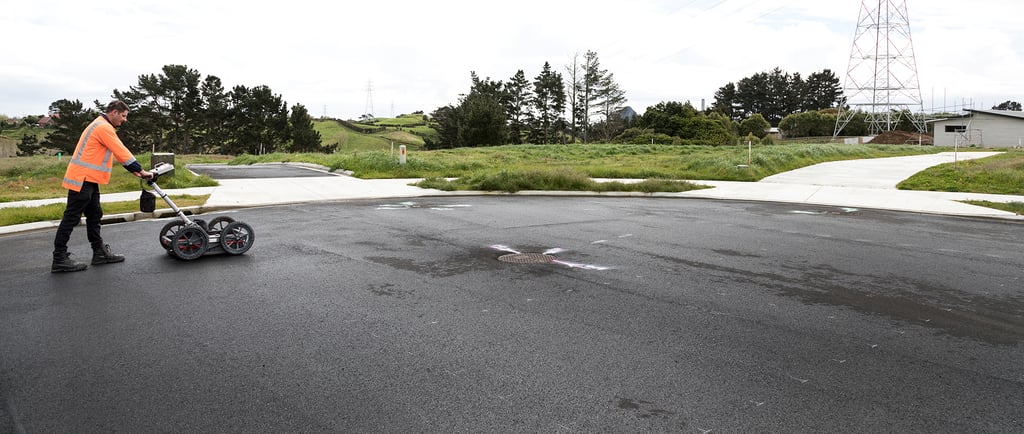
At Subsurface Leak Detection, Ground-Penetrating Radar (GPR) is a core component of our investigative methodology. All field technicians are equipped with professional-grade GPR systems, and GPR is routinely deployed to locate non-metallic underground lines, evaluate subsurface conditions, and confirm suspected leak locations as part of our leak detection duties.
Why GPR Matters in Leak Detection
GPR is a non-destructive geophysical technology that transmits high-frequency radio waves into the ground and records reflections from subsurface features. Changes in material type, density, moisture content, and voids create measurable contrasts that can be interpreted by trained operators.
This makes GPR uniquely suited for leak detection operations, where critical targets often include:
Plastic and composite water service lines
Irrigation and pool plumbing
Sewer and storm piping
Unknown or undocumented utilities
Soil disturbances and moisture anomalies associated with active leaks
Unlike metal locators, GPR does not rely on electrical conductivity. As a result, it can image pipes and subsurface features regardless of material composition.
Locating Plastic Lines and Unknown Utilities
One of the most consistent applications of GPR in our work is locating plastic lines that cannot be traced conventionally. In many investigations, accurate line location is a prerequisite to effective leak detection. Understanding pipe routing, depth, and relationship to structures allows subsequent diagnostic methods—acoustic correlation, tracer gas, pressure testing, or sectional isolation—to be deployed with precision.
Using GPR, our technicians can:
Map the alignment of buried plastic water and sewer lines
Identify changes in depth, slope, and bedding
Detect crossings, transitions, and previously unknown utilities
Reduce unnecessary excavation and invasive exploration
This capability is particularly valuable in older properties, institutional campuses, and municipal systems where as-built drawings are incomplete, inaccurate, or unavailable.
Confirming and Refining Leak Locations
Beyond line locating, GPR plays a critical role in confirming suspected leak locations. Active leaks frequently alter surrounding soil conditions. Escaping water can create zones of elevated moisture, disturbed backfill, voids, or differential settlement—all of which may produce distinct GPR signatures.
During leak investigations, GPR is commonly used to:
Corroborate acoustic or tracer-gas findings
Identify subsurface anomalies consistent with leakage
Refine excavation targets to a specific zone
Evaluate whether anomalies extend beyond a single point source
This confirmation step significantly improves confidence in final determinations and helps stakeholders make informed decisions before excavation or repair.
Integrated, Technician-Deployed Technology
At Subsurface Leak Detection, GPR is not a specialty add-on—it is standard equipment. All technicians carry and are trained in the deployment and interpretation of professional GPR systems. This ensures that subsurface imaging is available in real time, on site, and fully integrated with other diagnostic methods.
By combining GPR with complementary technologies such as acoustic survey, correlation, tracer gas, and pressure diagnostics, we are able to develop a multi-layered understanding of each system we investigate. This integrated approach reduces uncertainty, limits disruption, and increases the reliability of conclusions.
Supporting Accurate, Defensible Outcomes
Leak detection is not simply about finding water—it is about providing defensible, technically supported conclusions. GPR contributes to this by documenting subsurface conditions that are otherwise invisible, offering a permanent digital record of findings, and helping distinguish between potential sources of anomalies.
Whether locating non-metallic piping, confirming suspected leak points, or supporting excavation planning, GPR enhances the quality and credibility of our work.
About Subsurface Leak Detection
Subsurface Leak Detection specializes in advanced, non-destructive leak detection and subsurface diagnostics. Through the routine use of Ground-Penetrating Radar and other professional technologies, our technicians deliver precise, informed, and reliable results across residential, commercial, and municipal environments.
Need Leak Detection? Call (719) 749-6850 or (303) 520-0778
102 S Tejon, Colorado Springs, CO 80903
1600 S Broadway, Denver, CO 80202
Denver Metro (303) 520-0778 Colorado Springs (719) 749-6850